


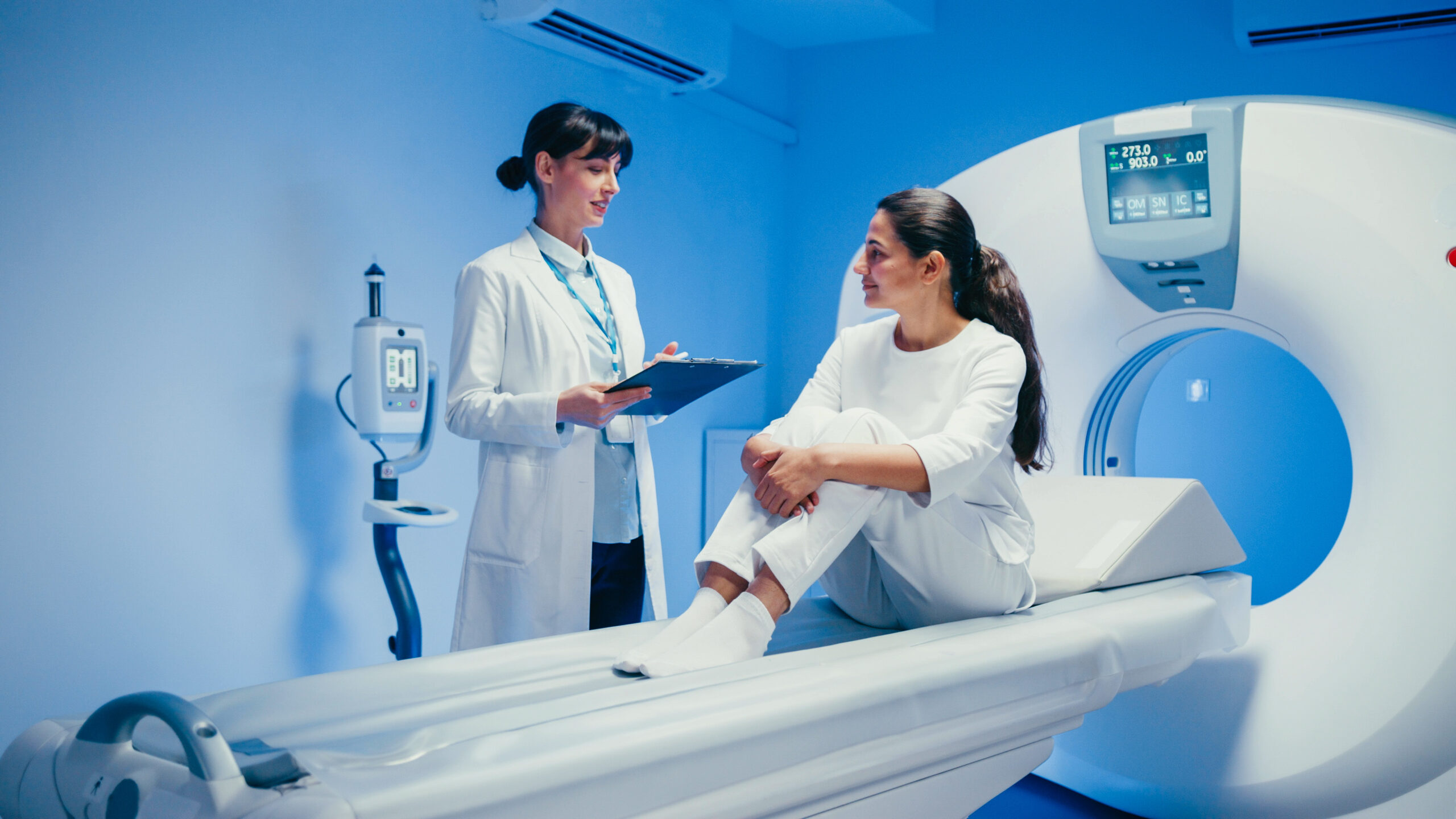
When a doctor recommends an MRI, it usually comes at a time of uncertainty. You want answers that are accurate, timely, and clear enough to guide the right treatment. That’s exactly where we come in at Orbit Imaging—we combine advanced 3 Tesla MRI technology with clinical expertise to ensure you don’t have to settle for anything less than a precise diagnosis.
We don’t just offer MRI scans; we provide clarity, confidence, and a smoother diagnostic experience across all our centres in Delhi.
Why Choosing the Right MRI Centre Matters
Not all MRI scans deliver the same level of detail. The quality of imaging directly affects how quickly and accurately a condition is diagnosed.
At Orbit Imaging, we use a 3 Tesla (3T) MRI, which offers:
- Higher resolution images for better diagnosis
- Faster scan times, reducing discomfort
- Greater accuracy, minimising repeat scans
This means your doctor gets the information they need—without delays or ambiguity.
Choosing the Right MRI: Screening vs. Diagnostic Scans
Not every MRI is ordered for the same reason. Some are done to catch problems early, while others are used to investigate specific symptoms.
- Preventive Screening (Whole-Body MRI)
We offer this for individuals who may not have symptoms but want a thorough health check. It helps detect hidden conditions early, often before they become serious. - Diagnostic Precision (Targeted Scans)
When symptoms like back pain, headaches, or joint issues arise, we perform focused scans such as spine or brain MRI to identify the exact cause with clarity.
The Orbit Edge
Whether it’s a preventive check or a detailed diagnosis, our 3 Tesla MRI ensures high accuracy, helping doctors make confident and timely decisions.
Types of MRI We Provide (Based on Imaging Technique)
We offer a wide range of MRI techniques, each designed to answer a specific clinical question. Instead of overwhelming you with technical terms, here’s how these scans actually help in real-life diagnosis.
1. Structural & Detailed Imaging
- T1-weighted MRI
We use this to capture clear anatomical structures. It helps in identifying tumours, brain structure abnormalities, and detailed tissue mapping. - T2-weighted MRI
This highlights fluid and swelling, making it extremely useful in detecting infections, inflammation, and internal injuries. - FLAIR MRI (Fluid-Attenuated Inversion Recovery)
We rely on this advanced sequence to detect subtle brain lesions, especially in conditions like multiple sclerosis, where standard scans may miss early changes.
2. Emergency & Functional Imaging
- Diffusion-Weighted Imaging (DWI)
When every second matters—such as in suspected stroke—this scan helps us detect early changes quickly, enabling faster medical intervention. - Perfusion MRI
We assess blood flow in tissues, which is critical in evaluating strokes and tumours. - Functional MRI (fMRI)
This allows us to map brain activity, helping doctors understand areas responsible for speech, movement, and other vital functions—especially before surgery.
3. Vascular Imaging (Blood Vessels)
- MR Angiography (MRA)
We visualise arteries to detect blockages, aneurysms, or narrowing of blood vessels. - MR Venography (MRV)
This focuses on veins and helps identify clots or venous abnormalities.
These scans are essential when symptoms point toward vascular conditions that require immediate attention.
MRI Scans Based on Body Area
Different health concerns require focused imaging. At Orbit Imaging, we provide specialised MRI scans for every major part of the body:
- Brain MRI – for neurological conditions, headaches, seizures
- Spine MRI – for back pain, slipped discs, nerve compression
- Musculoskeletal MRI – for joints like the knee, shoulder, and ligaments
- Cardiac MRI – for heart structure and function
- Abdominal MRI – for liver, pancreas, kidneys
- Pelvic MRI – for uterus, prostate, bladder
- Breast MRI – for detailed breast tissue evaluation
Each scan is performed using optimised protocols to ensure maximum clarity.
Contrast vs Non-Contrast MRI: What We Recommend
Sometimes, a basic scan is enough. In other cases, more detail is necessary.
| Type of MRI | When We Use It | Your Benefit |
| Non-Contrast MRI | Routine imaging | Safe, quick, no dye required |
| Contrast MRI | Tumours, infections, vascular issues | Enhanced visibility and precise diagnosis |
We use gadolinium contrast only when clinically required, ensuring both safety and diagnostic accuracy.

Types of MRI We Provide at Orbit Imaging: Precision You Can Trust
Specialised MRI Services We Offer
Beyond standard scans, we also provide advanced MRI techniques for complex conditions:
- MR Spectroscopy (MRS) – analyses tissue chemistry, helpful in tumour evaluation
- Whole-Body MRI – comprehensive screening, especially for cancer detection
- Enterography MRI – detailed imaging of intestines (e.g., Crohn’s disease)
- Cine MRI – captures moving images, ideal for heart function analysis
These specialised scans are part of our commitment to offering complete diagnostic solutions under one roof.
Advanced MRI Sub-Types for Complex Diagnosis
Some conditions require more than routine imaging. In such cases, we use highly specialised MRI techniques to provide deeper clinical insights.
- Neurological Excellence
We go beyond standard brain scans with advanced techniques like functional imaging and spectroscopy. These help in understanding brain activity and tissue changes, especially useful in complex neurological conditions and surgical planning. - Vascular & Cardiac Expertise
Our advanced vascular and cardiac MRI scans allow us to study blood flow and heart motion in detail. This often reduces the need for more invasive diagnostic procedures. - Oncology-Focused Imaging
For cancer detection and monitoring, we use optimised contrast and diffusion-based imaging. This helps in accurate staging and tracking treatment response with high precision.
This level of specialisation ensures that even the most complex cases are handled with clarity and confidence.
Find the Best Diagnostic Centre for Bone DEXA Scan in Delhi. Get accurate bone density tests, advanced technology, and reliable reports for better health.
What Makes Orbit Imaging the Preferred MRI Centre
Choosing where to get your MRI is just as important as the scan itself. We focus on delivering both medical accuracy and a comfortable patient experience.
Here’s what sets us apart:
- 3 Tesla MRI technology for superior image quality
- Experienced radiologists ensure reliable interpretation
- Faster scan completion with minimal discomfort
- Multiple centres across Delhi for easy access
- Streamlined appointment process to save your time
Conveniently Located Across Delhi
We believe advanced diagnostics should be easily accessible. That’s why Orbit Imaging is present in:
- MRI Scan Centre in Karol Bagh
- MRI Scan Centre in Rohini
- MRI Scan Centre in Green Park
- MRI Scan Centre in Dwarka
- MRI Scan Centre in Paschim Vihar
- MRI Scan Centre in Dilshad Garden
No matter where you are, a high-quality MRI scan is always within reach.
A Simple Way to Understand MRI Types
To make things easier:
- T1 / T2 → Basic structure and inflammation
- DWI → Early stroke detection
- fMRI → Brain activity mapping
- MRA / MRV → Blood vessel imaging
- Contrast MRI → Detailed disease detection
Each type serves a purpose—and we ensure you get the right one, not just any one.
Your Health Deserves Clarity, Not Guesswork
An MRI is often the turning point in diagnosis. The difference between a standard scan and a high-resolution 3T MRI can directly impact treatment decisions.
At Orbit Imaging, we take that responsibility seriously. From advanced technology to expert reporting, every step is designed to give you answers you can trust.
If your doctor has recommended an MRI, don’t delay it—or compromise on quality.
Experience the 3 Tesla difference. Schedule your appointment at our nearest facility and get your reports interpreted by Delhi’s leading radiologists.
Frequently Asked Questions
Is MRI safe for people with implants or medical devices?
MRI is generally safe, but certain implants like pacemakers or metal clips may require special precautions. Our team carefully evaluates your condition beforehand to ensure complete safety during the scan.
How long does an MRI scan usually take?
Most MRI scans take between 20 to 45 minutes, depending on the area being examined and the type of imaging required. With our advanced technology, we aim to keep the process as quick and comfortable as possible.
Will we feel any pain or discomfort during the scan?
MRI is a non-invasive and painless procedure. Some patients may feel slight discomfort from lying still or due to the machine noise, but we guide you throughout to keep you at ease.
When can we expect the MRI report?
We understand the importance of timely results, so we ensure reports are delivered as quickly as possible. In most cases, you can expect your report within a short turnaround time, without compromising on accuracy.